Product story
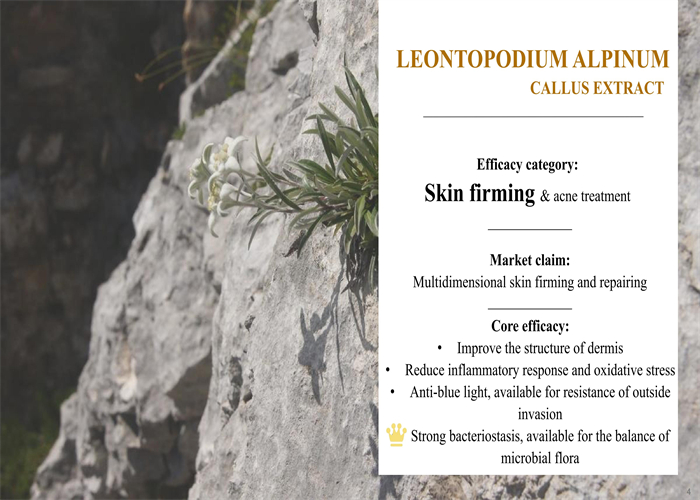
Alpine tinder (Leontopodium alpinum Colm. ex Cass.) : A perennial herb, usually 15-25 cm tall. Rhizomes branched short, leaves basal, linear, both sides covered with white pilose; Phylloid involucral bracts mostly, ovate to linear-oblong, full of white hairs, spreading around into a star-shaped, small inflorescence, mostly dense at branch tops, into pale yellow spheres. Bone several to more than 10 fascicled flower stems and a few sterile stems homomorphic with flower stems, without rosette clusters.
It grows in high mountain areas with rocks and limestone. It is native to alpine and subalpine forests, dry shrubland, dry grasslands and grasslands at altitudes of 1400-3500 m, often growing in patches. It is native to the mountains of Europe. Its distribution ranges from the Pyrenees to the Alps and east to the Balkan Peninsula in central Bulgaria, and is typical of plant communities exposed on ridges. It is widely cultivated.
The main value is to appreciate the hairy leaves and involubracts, which can be retained regularly after drying. It is an important monument for tourists in the Alps. It is cultivated in rock gardens with alpine scenery, and sometimes in indoor potted plants. Has been introduced into the world of cultivation, the wool is dense and mixed with glandular hair, with lemon flavor, very popular. Alpine tinder is listed as a protected plant in many countries and is the national flower of Switzerland and Austria. It is a famous alpine flower in Europe. The genus name comes from the Greek words leon meaning lion and podion meaning foot. The flowers and bracted leaves are said to resemble lion claws.
Product efficacy
Multidimensional skin firming and repairingv:
Improve the structure of dermis
Reduce inflammatory response and oxidative stress
Reduce inflammatory response and oxidative stress
Strong bacteriostasis, available for the balance of microbial flora



 023-68867721
  Service hotline
023-68867721
18201230206
Service hotline
023-68867721
18201230206